
The Tiny Cups and Little Bags Filling Our Trash: What We Learned About Coffee Pods and Tea Bags
Coffee pods and most tea bags are full of plastic, and recycling them rarely works out. Here's what we found, and the whole-bean and loose-leaf habits that replaced them for us (and cut down our Starbucks runs).
Disclosure: This article includes affiliate links. If you buy through them, we may earn a small commission at no extra cost to you. We only share things we use ourselves or would honestly point a friend to. The article comes first, always.
During the pandemic, like a lot of families stuck at home, we bought an espresso machine. We never went back. That one purchase quietly replaced the Nespresso capsules and a whole lot of trips to Starbucks, along with all the paper cups, plastic lids, and cardboard sleeves that came with them.
Our tea habit changed a few years ago too, when we switched to loose-leaf. The quality is so much better, and there’s a lot less trash and a lot fewer boxes shipping back and forth.
Neither switch started as an environmental decision. But looking back, I got curious: what exactly did we stop throwing away? So I looked into what happens to coffee pods and tea bags. The answer is less comforting than the “recyclable” label suggests.
The Coffee Pod Problem
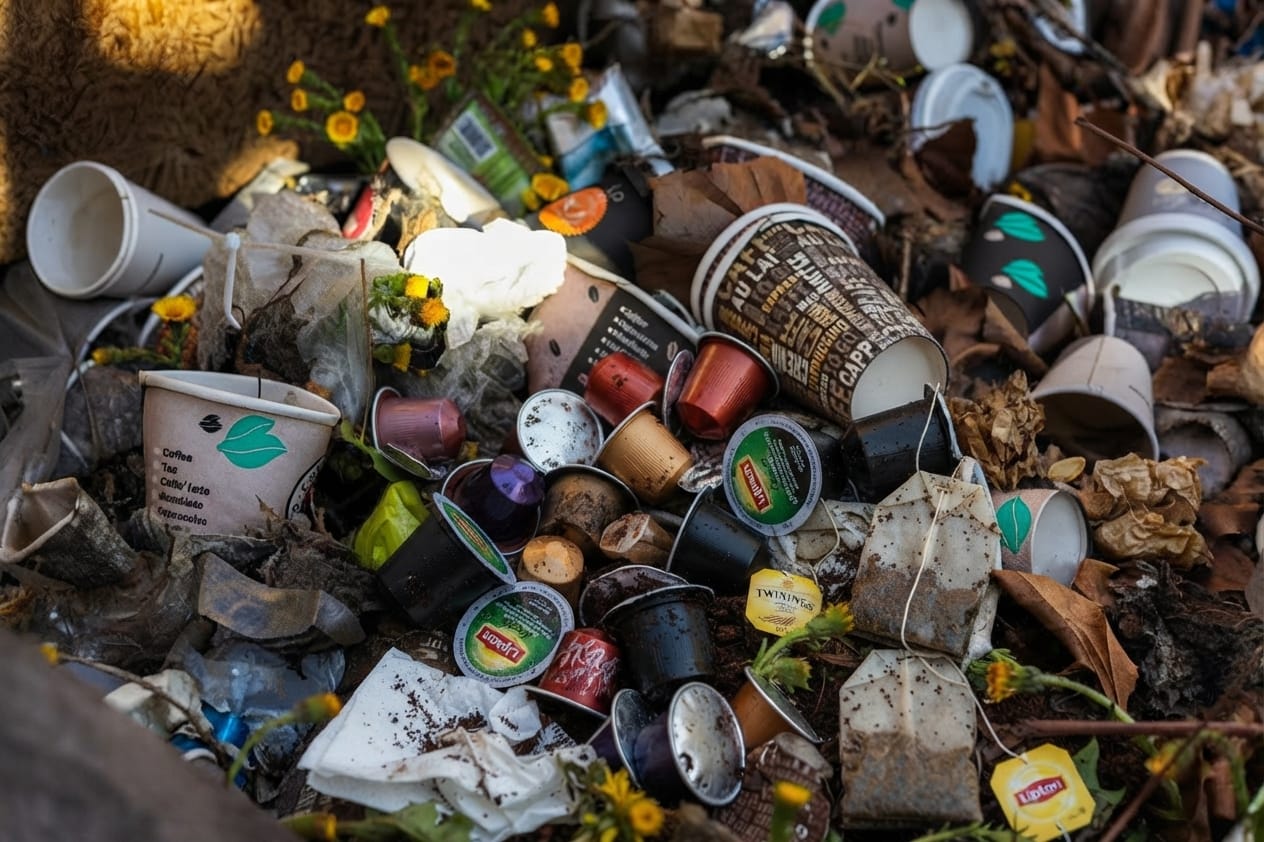
Pods are convenient. That’s the whole idea. You push a button and you get coffee with no measuring and no mess. That convenience creates a lot of trash.
In 2014 alone, Keurig sold about 9.8 billion K-Cups. Lined up end to end, the used pods from that one year would circle the Earth more than ten times. And that’s one brand in one year, before the Nespresso-style capsules, store brands, and every pod sold since.
Here’s the part that got me: John Sylvan, the man who invented the K-Cup, regrets it. In a 2015 interview with CBC, he said he doesn’t own a pod machine, finds them expensive per cup, and said flatly, “You can’t recycle that package, I don’t care what Green Mountain says.” He makes a full pot of coffee in a thermal carafe instead.
”Recyclable” Doesn’t Mean It Gets Recycled
Most K-Cups today are made of #5 plastic (polypropylene) and are labeled recyclable. In theory, you peel off the foil lid, empty out the grounds, and toss the cup in the bin.
In practice, it’s a mess. Pods are small, and small things often fall through the sorting screens at recycling facilities. (We wrote about this in our recycling bin article: anything smaller than a credit card is in trouble.) A lot of people also skip the peeling and emptying, which means the pod is contaminated before it gets to the bin.
Regulators have noticed. In 2022, Canada’s Competition Bureau fined Keurig Canada $3 million (plus $800,000 in donations) over misleading recyclability claims. The Bureau found that the pods weren’t widely accepted for recycling outside British Columbia and Quebec. A Canadian class action over the same claims later moved toward its own settlement.
Back in 2016, Hamburg, Germany went further and banned single-use coffee pods from government buildings. The city’s environment senator said that when you look at waste, energy efficiency, and cost, “it makes no sense buying those machines.”
To Be Fair to the Pods…
We promised ourselves we’d be honest even when the facts get complicated. Here’s the complicated part.
A 2023 study from the University of Quebec compared the carbon footprint of different brewing methods. It found that most of coffee’s footprint comes from growing the beans, not the packaging. Old-school drip coffee came out worse than pods in that study, because people tend to use too much coffee and heat too much water. A pod forces you to use exactly the right amount.
So the pod’s real problem isn’t so much carbon. It’s waste: billions of little plastic-and-aluminum cups headed for landfill every year. The study’s authors also pointed out that pods are so easy that people tend to drink more coffee, which cancels out the efficiency.
What we took from it: the greenest cup is the one where you don’t waste coffee and don’t throw away a container. That’s where whole beans came in.
What Replaced Pods for Us: Whole Beans
The machine we bought during the pandemic is a Philips espresso machine, and we still love it. It grinds whole beans fresh for every cup, so there’s no pod and nothing to peel or rinse. The used grounds drop into a container that we empty into our compost (coffee grounds are great for the garden). The milk system makes lattes and cappuccinos at the push of a button, so it’s every bit as easy as a pod machine.
The surprise was the money. Between Nespresso capsules and stops at the closest Starbucks, our coffee was costing more than I’d like to admit. Around here, a latte runs about $6. Making the same drink at home with good beans and our own milk costs roughly a dollar. If you swap out four coffee-shop drinks a week, that’s about $20 a week, or around $1,000 a year. The machine isn’t cheap, but at that pace it pays for itself in about a year.
And there’s the trash. Every coffee shop drink comes in a paper cup with a plastic lining, plus a plastic lid and often a sleeve. Those cups generally can’t be recycled. Skipping the drive-through cut out a surprising amount of garbage from our week.
We also buy our beans in bigger bags, which means less packaging per cup than pods could ever manage.
You don’t need a fancy machine
An espresso machine was what fit our house, but the habit matters more than the equipment. A French press or a pour-over cone does the same job for very little money: no pods, no paper filters, and it lasts forever.
And if you already own a pod machine, don’t throw it out. That would just create a different kind of waste. Refillable pods exist that let you use your own coffee in the machine you already have.
Now About Tea
I assumed tea was the innocent one. A tea bag is paper, right?
Not always. Many tea bags contain plastic. Some “premium” pyramid bags are made entirely of nylon or PET (polyester). And plenty of regular-looking paper bags are sealed with polypropylene, a plastic that helps them hold their shape in hot water. That means they don’t fully break down in compost.
It gets worse once the bag is in your cup.
In 2019, researchers at McGill University steeped plastic tea bags in 95°C (203°F) water and found that a single bag released about 11.6 billion microplastic particles and 3.1 billion nanoplastic particles into the cup. The study was published in Environmental Science & Technology.
In 2024, a team at the Autonomous University of Barcelona tested commercial tea bags made from polypropylene, nylon, and cellulose. They found that the polypropylene bags released about 1.2 billion particles per milliliter of tea. In lab tests, those particles were absorbed by human intestinal cells. Scientists are still working out what that means for health. I’d still rather not steep plastic in my morning tea while they figure it out.
Some brands have moved to plastic-free bags, which is great. But the simplest fix skips the bag entirely.
Skipping the Bag: Loose-Leaf Tea
A few years ago we switched to loose-leaf tea, and our favorite is the Full Leaf Tea Company. (We don’t earn a commission from them. We just like their tea.) Their teas come as whole leaves instead of the dust-and-fannings that end up in most bags. You can actually taste the difference. Whole leaves unfold as they steep, and you can usually get two or three steepings out of the same leaves.
To brew it, we use reusable silicone tea bags. You scoop in the leaves, drop the bag into your mug, and pull it out when it’s ready. Afterward the used leaves go into the compost, the silicone bag gets a quick rinse, and that’s it. They’re reusable for years.
A note on silicone: it isn’t the same as the polypropylene or nylon in tea bags. Food-grade silicone is made to handle high heat and is far sturdier than the thin plastic mesh in tea bags, though research on what any material sheds in hot water is still young. If you’d rather avoid it, a stainless steel mesh infuser works just as well.
Loose-leaf tea is also cheaper per cup than you’d expect, especially since the leaves can be steeped more than once. And because a bag of whole leaves lasts us a long time, we’re ordering less often, which means fewer packages making the trip to our door.
What We’re Still Figuring Out
We’re not perfect at this, and I won’t pretend I’ve never stopped at Starbucks on a busy morning since the pandemic.
The bigger lesson for us was about the word “recyclable.” It made us feel fine about something that, most of the time, ends up in a landfill anyway. The pod and the tea bag aren’t really the villains here. It’s the habit of buying something we use once and throw away, every single day, without thinking about it.
Swapping that habit for whole beans, loose leaves, and a compost bin turned out to be easier than we expected. It also tastes better and costs less. We didn’t see that last part coming.
Sources
- K-Cup Inventor Regrets Creating Non-Recyclable Keurig Coffee Pod — CBC
- Keurig Canada Fined $3M Over Recyclability Claims of K-Cup Pods — Food Manufacturing
- Keurig Pod Recyclability Class Action in Canada Heads Toward Settlement — Daily Coffee News
- Hamburg Becomes the First City to Reject Single-Use Coffee Pods — CBC
- Are Coffee Pods Better for the Environment Than You Thought? — Euronews
- Yeah, Actually, Your Plastic Coffee Pod May Not Be Great for the Planet — NPR
- Some Tea Bags May Shed Billions of Microplastics per Cup — CBC (McGill study)
- Plastic Tea Bags Update: How to Avoid Harmful Release — Newsweek (UAB study)
- Make My Tea Plastic-Free — Beyond Plastics
What we use
Products mentioned in this article — affiliate links support this site at no cost to you.
Philips 5500 Series Fully Automatic Espresso Machine
The machine we bought during the pandemic and still use every day
Reusable Silicone Tea Bags
What we brew loose-leaf tea in; the leaves go to the compost and the bag gets a rinse