
I Traded My Saline Spray Cans for a Ceramic Neti Pot. Here's What Else Changed About Our Cold Season.
Sinus trouble every fall used to mean a drawer of empty saline spray cans. Here's the ceramic rinse and bathroom kettle that replaced them, how to keep the water safe, why honey and lemon beat a cabinet of plastic-wrapped cold medicine, and other small swaps for when the rain comes back.
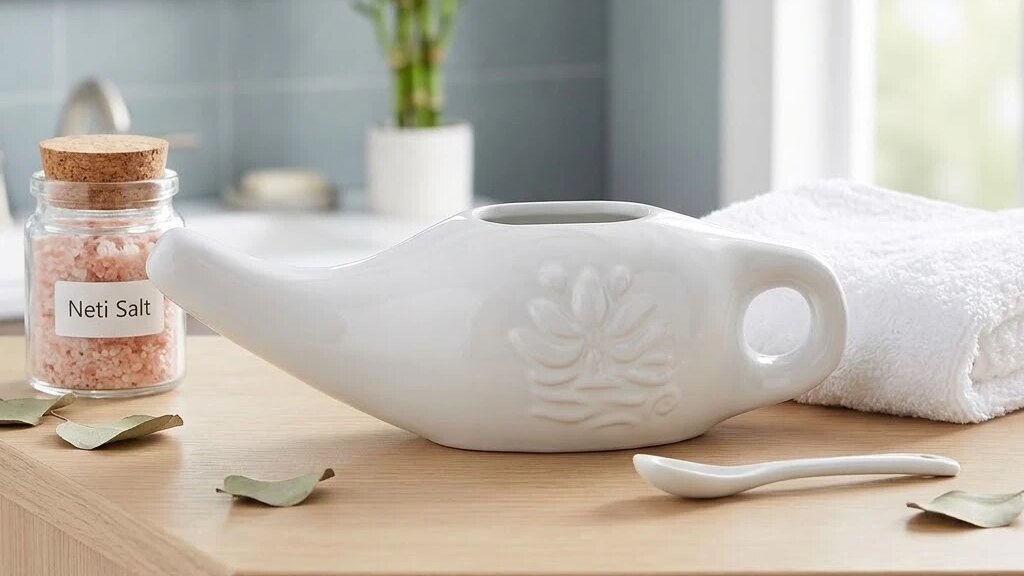
Disclosure: This article includes affiliate links. If you buy through them, we may earn a small commission at no extra cost to you. We only share things we use ourselves or would honestly point a friend to. The article comes first, always.
Sometime in October the rain comes back to Seattle and stays, and my sinuses notice before I do. Every year it’s the same: a heavy head in the mornings, that pressure behind the eyes, and a week or two when I’m reaching for something to clear it all out.
For years that something was a pressurized saline spray. The kind in a metal can with a little nozzle, the one that hisses a fine mist. It worked. It was also, I realized one morning while digging through the bathroom drawer, a can I emptied every few weeks. By the end of the season there was a small pile of them.
So this year looks different. A ceramic neti pot on the counter, and a small electric kettle-mug that lives in the bathroom. Here’s how that works, the one safety rule I had to learn properly, and the other things we’ve been rethinking for cold season.
I’m not a doctor, and nothing here is medical advice. If you have ongoing sinus problems, or you’re thinking about rinsing a child’s sinuses, talk to your doctor first.
The spray can
Pressurized saline sprays have real advantages. The saline inside is sterile, the can is sealed, and you don’t have to think about water at all. If you travel a lot or rinse only now and then, I understand the appeal.
But each one is a metal can with a plastic cap and nozzle, and in a bad sinus month I was going through them quickly. Whether an empty aerosol can is recyclable depends entirely on where you live. Some cities take empty cans in curbside recycling; others want them at a scrap metal or household hazardous waste drop-off. It’s worth checking your city’s rules rather than guessing. (If you’ve read our recycling bin article, you know how often guessing goes wrong.)
The ceramic pot
A neti pot is the oldest version of this idea: a small pot with a spout. You fill it with lukewarm salt water, tilt your head over the sink, and let the water run in one nostril and out the other. The first time feels strange. By the third time it’s just part of the morning, somewhere between brushing teeth and putting the kettle on for tea.
Ours is ceramic, which I like for the same reason I like the tea tins in the kitchen: it doesn’t wear out. Rinse it, let it air dry upside down, and it’s ready for the next day. There’s no can to finish and no refill to buy, only salt and water.
The catch is the water. Most neti pot instructions point you to distilled water, the kind sold in gallon plastic jugs. Rinsing every day, that’s a jug every week or two, which would have traded one pile of containers for another. So I went a different way.
The water is the part that matters
This is the most important thing in this article.
Plain tap water is not safe for rinsing your sinuses. The FDA is direct about it: tap water isn’t adequately filtered or treated for this. Water that’s perfectly fine to drink can carry organisms that are harmless in your stomach but dangerous in your nose. They’re rare, but people have died from rinsing with tap water that carried an amoeba called Naegleria fowleri. It’s not something to be casual about.
The safe options, according to the FDA and the CDC:
- Distilled or sterile water, the kind sold in gallon jugs.
- Tap water that has been boiled and cooled. The FDA says boil it for 3 to 5 minutes, then let it cool until lukewarm. The CDC says at least 1 minute at a rolling boil (3 minutes if you live above 6,500 feet).
- Water run through a filter specifically designed to trap these organisms. (I haven’t gone this route, so I can’t say much about it.)
Boiling is where the bathroom kettle-mug comes in. Instead of buying jugs, I boil tap water in the bathroom, let it cool, and use it. The FDA says boiled water keeps for up to 24 hours in a clean, closed container, so one batch in the evening covers the next morning.
One thing I had to check: many electric kettles switch off the moment the water reaches a boil. That’s not the same as boiling it for one minute, let alone three to five. If yours shuts off automatically, you need to bring it back to a boil until it has actually boiled for the full time, or use a pot on the stove. It’s a small habit, but it’s the whole point.
Our routine: At night I fill the kettle-mug and bring it to a boil, then let it boil a few more times while I shower, switching it back on each time it clicks off, until it has boiled for several minutes in all. I leave it covered overnight. By morning it has cooled down, and it’s ready for the rinse, well within the 24 hours the FDA allows.
What that adds up to
I wanted a rough number, so here’s the back-of-the-envelope version. Your own numbers will be different, and these are estimates, not measurements.
The spray cans. I was emptying a can about every three weeks. Our sinus season runs roughly from October to April, about 26 weeks, so that’s 8 or 9 cans a season.
The jugs I didn’t buy. A typical rinse uses about 8 ounces of water, and a gallon jug holds 128 ounces, so one jug covers about 16 rinses. Rinsing once a day through the same 26 weeks, the “use distilled water” route would have meant about 11 gallon jugs a season.
So depending on what you’d otherwise be using, one ceramic pot and a kettle-mug skip about 9 metal cans or about 11 plastic jugs every season. Rinse all year and it’s closer to 17 cans or 23 jugs. Over five years of fall rains, that’s somewhere around 45 cans or 55 jugs, from one pot that will probably outlast all of them.
The salt
Pre-mixed saline packets are convenient, but each one is a little foil or paper sachet. The American Academy of Allergy, Asthma & Immunology publishes a simple recipe for making your own:
- 3 teaspoons of pickling or canning salt (no iodine, no anti-caking agents, no preservatives, which can irritate the inside of your nose)
- 1 teaspoon of baking soda
- Mix them and keep the mix in an airtight container.
- Use 1 teaspoon of the mix per 8 ounces of lukewarm water. If it stings, use a little less.
That’s one more glass jar from the pantry put back to work, the same way our old jam jars hold dried chiles and spices. A box of canning salt lasts a very long time.
Honey, lemon, and hot water
Walk down the cold and flu aisle and count the plastic. Syrup in plastic bottles with a plastic dosing cup clipped to the cap. Capsules sealed one by one in plastic-and-foil blister packs, inside a cardboard box. Powder sachets for hot drinks, each its own little packet. Almost none of it is recyclable, and a family of four with a cold going around the house can empty a lot of it in one season.
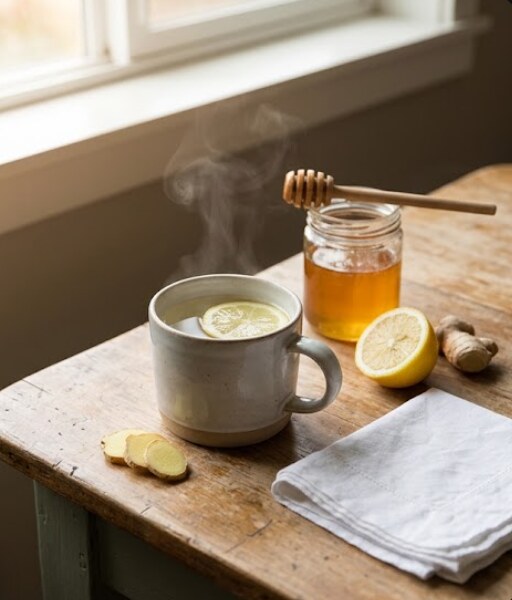
At our house, the first thing anyone gets when they’re under the weather is a mug of hot water with a squeeze of lemon, a spoonful of honey, and a few slices of fresh ginger if we have some. The lemon peel goes in the compost, and the honey jar gets washed and reused like every other jar in our kitchen. My grandmother would have made the same thing, probably with whatever was growing in the yard that week.
It’s not a cure, and it doesn’t replace medicine when someone actually needs it. If there’s a fever that won’t come down, or a cough that won’t quit, that’s a call to the doctor. But for the scratchy throat and the general misery of an ordinary cold, a warm mug does a lot, and it leaves nothing behind but a lemon rind. Loose-leaf tea from the tins works too.
One important note: honey is not safe for babies under one year old.
Other things worth rethinking this season
Cold and allergy season fills a house with small disposable things. Not all of them have a better option, and some of them shouldn’t be swapped (medicine is medicine). But a few are easy.
Handkerchiefs. My grandmother never owned a box of tissues. She had a stack of cotton handkerchiefs, ironed and folded, and they went in the wash with everything else. A few soft cotton handkerchiefs go a long way through a cold, as long as they go straight into the laundry after a sick day.
A warm compress instead of disposable heat packs. A washcloth soaked in hot water and wrung out, held over the cheeks and forehead, does the same job as a single-use heat pack. A cotton sock filled with dry rice and warmed in the microwave for 30 seconds or so holds heat even longer. (Test it on your wrist first. It gets hotter than you’d expect.)
Steam from the shower. A hot shower with the door closed is a free steam room. No gadget required.
Cough drops in bulk. If you use them, a tin or a single bag of loose drops means less wrapper waste than the boxes where every drop is individually wrapped.
Clean the humidifier. If you run one through the winter, it needs regular cleaning and fresh water. A dirty humidifier just puts whatever is growing in the tank into the air you breathe.
Old medicine goes back, not in the trash. Washington has a free statewide take-back program: drop-off kiosks at many pharmacies and police stations, plus free mail-back envelopes, for both prescription and over-the-counter medicine (and pet medicine too). Before the season starts is a good time to go through the cabinet. Many other states and pharmacies have similar programs.
What we’re still figuring out
The neti pot is a habit that only works when you have the ten minutes it takes to boil the water and let it cool. On a rushed morning, that’s ten minutes I don’t always have, which is why the boil-the-night-before routine matters so much. And when I travel, I’m honestly not sure what the best answer is yet. Distilled water from a store, probably, or a kettle in the hotel room if I can trust it to boil long enough.
The rain will keep going until spring. The pot stays on the counter.
Sources
- Is Rinsing Your Sinuses With Neti Pots Safe? — U.S. Food and Drug Administration
- How to Safely Rinse Sinuses — Centers for Disease Control and Prevention
- Saline Sinus Rinse Recipe — American Academy of Allergy, Asthma & Immunology
- Safe Medication Return — Washington State Department of Health
- Aerosol can disposal guidance — Washington State Department of Ecology
What we use
Products mentioned in this article — affiliate links support this site at no cost to you.
Himalayan Porcelain Neti Pot
The ceramic pot on our bathroom counter that replaced the saline spray cans
Rzlinn Stainless Steel Electric Kettle Mug
The small kettle-mug we boil rinse water in the night before