
The Halloween Stuff That's Worth Keeping: What to Invest In, What to Skip, and How to Get Creative
We got tired of re-buying the same flimsy Halloween decorations every October. Here's what we figured out about which stuff is worth spending a little more on, where to get creative, and what's honestly fine to skip.

Last October, about twenty minutes before the first trick-or-treaters showed up, I was in the garage trying to inflate a giant spider that we’d bought the year before. One of its legs had a seam tear from storage, the fan motor was making a sound that suggested it had lived its best life already, and the whole thing looked like a deflated pool toy having a bad day. We’d spent maybe $25 on it, used it exactly once, and here it was — done. Meanwhile, the $8 plastic skeleton from the dollar store was somehow fine for its third year running, just standing there being reliable.
That’s when it hit me: we’d been approaching Halloween stuff completely backwards. Buying cheap across the board and replacing half of it every year isn’t actually cheaper. And the pile of cracked plastic pumpkins and shredded polyester spider webs we were sending to the trash every November was starting to feel like its own kind of horror story.
So we took a different approach. We looked at everything we buy or make for Halloween and asked a pretty simple question: will this still be good next October? The answers were more interesting than we expected.
This article includes affiliate links. If you purchase through them, we may earn a small commission at no extra cost to you. We only recommend products we’ve actually used or genuinely researched — the article exists because the topic matters to us, not because of the links.
The Numbers Are Genuinely Scary
Before getting into the fun part, the waste numbers are worth knowing because they’re what pushed us to actually change.
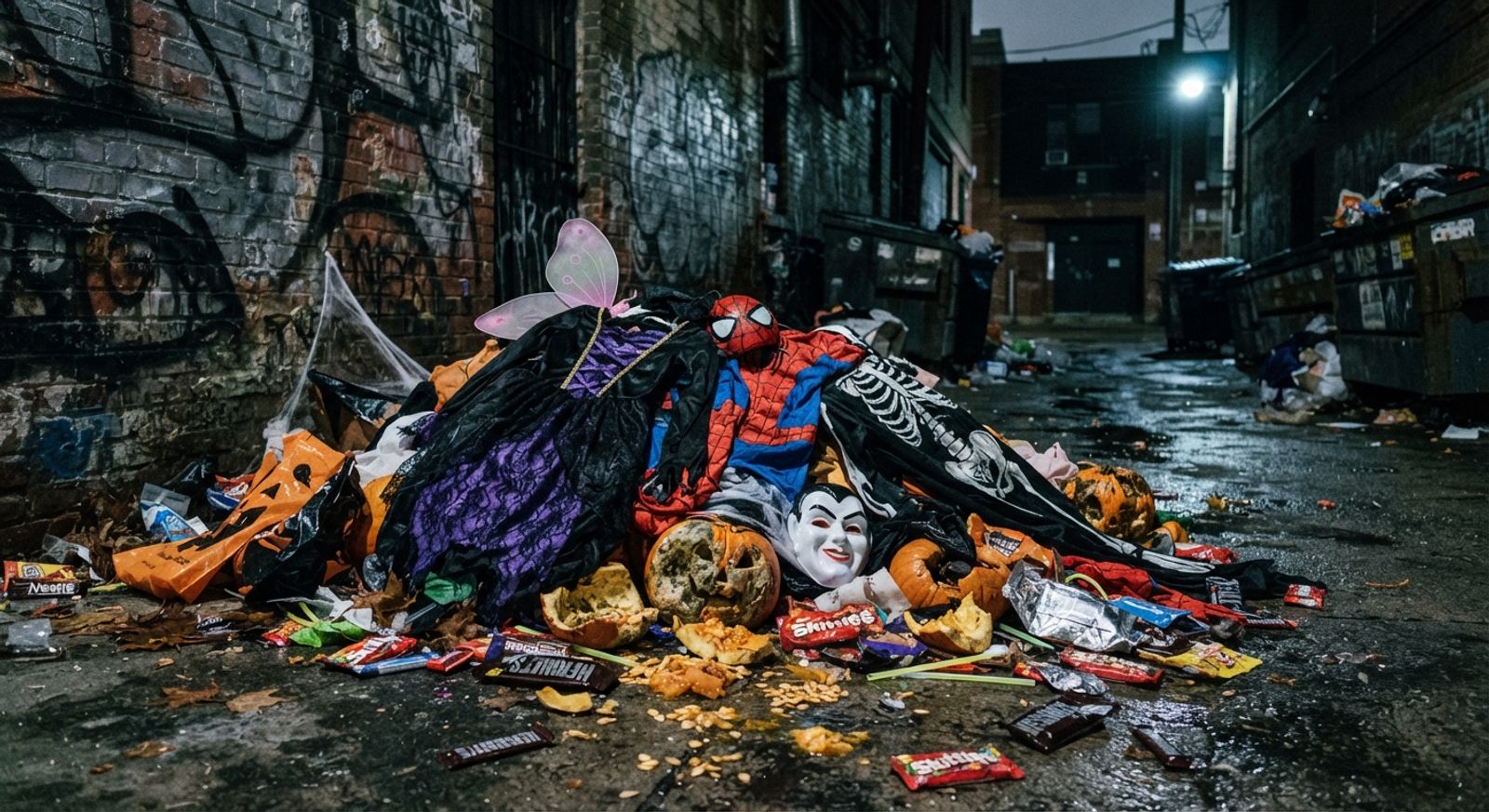
About 35 million Halloween costumes get thrown away every year in the U.S. alone. Roughly 83% of all costumes are made from non-recyclable, oil-based plastics — polyester, nylon, acrylic — that will sit in a landfill for somewhere between 20 and 200 years. Four out of ten costumes get worn exactly once. Americans spend north of $11 billion on Halloween annually, and a meaningful chunk of that spending produces things that last one evening.
Then there’s the pumpkin situation — about a billion pounds of pumpkins end up in landfills globally each year, where they decompose and release methane, a greenhouse gas roughly 80 times more potent than CO₂ over a 20-year period. And the candy wrapper problem is its own category: billions of individually wrapped pieces in non-recyclable mixed-material wrappers.
None of this means Halloween should feel guilty or joyless. It means some of the choices are worth thinking about, and a lot of the better options are actually more fun.
Where Spending More Actually Saves Money (and Waste)
Not everything deserves a bigger investment. But some Halloween categories have a clear “buy it once” option that pays for itself in two or three seasons. Here’s where we think the tradeoff works.
Outdoor Lighting
This is probably the single best place to spend a little more. A decent set of solar-powered LED string lights — orange, purple, warm white, whatever your vibe — will run for years with zero electricity cost and no wiring hassle. We found some good options at both Amazon and Walmart in the $15–30 range that are weatherproof and have multiple modes (steady, flicker, chase).
Walmart carries the Touch Of Eco Solar LED Halloween String Lights — 68 feet of purple and orange LEDs, solar-powered, weatherproof. Amazon has similar options from multiple brands. The key things to look for: waterproof rating (IP65 or higher), solar panel quality, and a black wire that disappears against tree branches and gutters.
Compare that to buying disposable string lights or glow sticks every year. The solar set pays for itself by year two, works without an outlet, and you toss it in a box every November.
Costumes (the Right Ones)
Here’s the nuance: not every costume is worth investing in. A trending pop-culture costume your kid wants this year might not interest them next October. That’s fine — that’s what thrift stores, costume swaps, and creative closet raids are for.
But base layer costumes and classic characters are a different story. A well-made witch cape, a quality skeleton bodysuit, a good pirate coat — these get reused year after year, by the same kid or handed down to siblings. The math actually works out: a $65 quality costume worn five times comes to $13 per wear. A $15 disposable one replaced annually costs $15 per wear plus the landfill contribution, plus the accessories you inevitably re-buy because last year’s fell apart.
What to look for: fabric weight of 125 GSM or higher (cheap costumes run 60–80 GSM and become see-through under party lighting), reinforced seams instead of single-stitch, and metal zippers instead of plastic. Morphsuits and similar brands have good guides on this — the difference between a costume that survives the washing machine and one that doesn’t is mostly in those construction details.
For kids who want something different every year — and they will — the sustainable play is a “costume kit” approach: invest in versatile base pieces (a good black cape, a quality tutu, a solid pair of wings) and swap out the cheap accessories that define the character each year. The $5 fairy wand is disposable; the $30 cape that makes the fairy, the witch, and the vampire work is the investment.
The Animated Candy Bowl
Okay, this one is partly just because our kids love it, but the motion-activated candy bowls with a skeleton hand or lunging head are genuinely a buy-once item that becomes a household tradition. Amazon has several versions — the FUNPENY Animated Pumpkin Candy Holder and the Needzo Animatronic Skeleton Candy Bowl both run on batteries, have motion sensors and sound effects, and are built to last multiple seasons. They run $20–35 and replace the need to buy a new candy display setup every year.
The trick-or-treaters love them, the bowl itself is reusable forever, and they turn candy distribution into an event instead of a chore.
Canvas Trick-or-Treat Bags
This is such an easy swap it’s almost embarrassing we didn’t do it sooner. Those thin plastic pumpkin buckets and flimsy bags that crack or tear mid-route? Replace them once with canvas tote bags and you’re done for years.
Amazon has packs of reusable canvas trick-or-treat bags with Halloween designs for around $8–12 for a four-pack. Walmart carries canvas bags with handles that are big enough to hold a serious candy haul. They fold flat for storage, they’re machine washable, and they actually hold more candy than those plastic buckets ever did — which the kids figured out immediately.
Where Getting Creative Beats Buying Anything
Some of the best Halloween stuff doesn’t come from a store. And honestly, a lot of it is more memorable than anything you’d buy.
The Yard Display That Costs Almost Nothing
Real pumpkins and gourds from a local farm or grocery store are decorations and compost. Carve them, paint them, stack them on the porch — and when Halloween’s over, they go in the compost bin or the yard waste, not the trash. One tip we picked up: painting pumpkins instead of carving them makes them last weeks longer (carved pumpkins start decomposing in about five days). And painted pumpkins from last year’s leftover acrylic paint? Free.
Dried corn stalks, hay bales (if you can find them locally), fallen leaves raked into a display — the natural material approach actually looks better than a yard full of plastic, and none of it needs to be stored. It just goes back to the earth.
DIY Decorations That Last
Some of the most charming Halloween decorations are homemade and reusable:
A fabric ghost made from an old white sheet draped over a ball on a stick takes five minutes and can hang from a tree for years. Mason jar lanterns with tissue paper faces become a family craft project and come out of the cupboard every October. Potion bottles made from thrifted glass bottles with hand-written labels look genuinely better than anything at the dollar store. A wreath made from grapevine or straw, decorated with dried oranges, cinnamon sticks, and a few fake spiders, lasts for years if stored dry.
The crocheted cotton spider web is one we haven’t tried yet but keep seeing — it replaces the stretchy polyester web that’s basically single-use (good luck getting that stuff back in the bag), it looks more realistic, and it’s actually reusable.
Thrift Stores as a Costume Workshop
This might be the most underrated Halloween move: thrift stores aren’t just where you find a cheap costume — they’re where you find the raw materials for a great one. An oversized blazer becomes a mad scientist coat. A vintage dress becomes a vampire’s gown. A leather jacket and some DIY patches become a post-apocalyptic survivor. The whole point is that you’re not buying a pre-packaged costume someone else designed — you’re building something original from pieces that already exist.
Our oldest is fifteen and she’s already deep into designing this year’s costume from thrift store finds. She’s been sketching ideas, hitting Goodwill for pieces, and altering things herself. It’s become a creative project she genuinely looks forward to — way more than picking something off a rack at Spirit Halloween ever was. And honestly, the costumes that come out of this process are better. They’re one-of-a-kind, they fit because you chose them, and the whole build is part of the fun.
For younger kids, thrift stores are where you find base pieces for cheap — a tutu, a cape, a pair of boots — that you combine with face paint and a couple of dollar-store accessories to make something specific. The cost is usually under $10 total, the costume is unique, and nothing was manufactured in a factory specifically to be worn once and thrown away.
The Costume Swap
Our neighborhood started doing a costume swap a couple of years ago and it’s become one of the better ideas anyone’s had. Families bring costumes their kids have outgrown, lay them out in someone’s garage, and everyone shops for free. The kids love it because they’re getting “new” costumes, the parents love it because it costs nothing, and a bunch of costumes that would have gone to Goodwill or the trash get another year of use.
If your neighborhood doesn’t do this, it takes about one Facebook or Nextdoor post to start one. The response is usually enthusiastic.
What’s Honestly Fine to Keep Simple
Not everything needs a sustainability overhaul. Some things are fine to keep low-cost and low-stress.
Candy. Yes, the wrappers are wasteful. No, we’re not going to be the house that gives out pencils. We buy candy, hand it out, and focus our sustainability energy on the categories where it actually makes a meaningful difference. If you want to go a step further, look for candy in paper-based or foil-only wrappers — they’re more recyclable than the mixed plastic-and-foil wrappers most candy uses. But no judgment from us either way.
Single-use party supplies for a big party. If you’re hosting thirty kids, paper plates and napkins make sense. Look for compostable options (they exist and they’re not much more expensive), but don’t beat yourself up about it. The bigger win is in the stuff you reuse year after year, not the plates from one party.
Trendy costumes. Your seven-year-old wants to be a character from this year’s movie and will not be that character ever again. That’s a thrift-store-find or a creative-closet situation, not a $60 investment. Save the investment money for the classic pieces that keep working.
A Quick Note on Inflatables
The big inflatable yard decorations are a category where the answer really depends. A quality inflatable — thick material, good fan motor, reinforced seams — can last five or more years and becomes a neighborhood landmark. A cheap one from the bargain bin might last one season before the seams go or the motor dies (ask me how I know).
If you want an inflatable, spend enough to get one that will last. Amazon has options from $30 to $100+ — the ones in the $50–70 range with reinforced stitching tend to hit the sweet spot. Or skip them entirely and put that energy into the natural and DIY approach, which honestly looks better in most yards.
The Storage That Makes It All Work
The secret to reusable Halloween decorations isn’t buying them — it’s storing them so they actually survive to next year. We learned this the hard way after finding a box of tangled lights and crushed decorations in the garage.
What works for us: one large plastic storage bin (itself reusable for decades), labeled “Halloween.” Lights wrapped around cardboard to prevent tangling. Costumes folded with a dryer sheet to keep them fresh. Inflatables and fabric items in their own ziplock bags to keep moisture out. Canvas bags folded flat at the bottom. The animated candy bowl wrapped in bubble wrap (yes, we’re that household now).
Ten minutes of organized packing in November saves the frantic re-buying spree every September.
Where We’ve Landed
We didn’t set out to have a zero-waste Halloween and we still don’t. We buy candy, we occasionally grab a cheap costume accessory, and we’re not going to pretend our household has this perfectly figured out. But the shift from “buy everything new, throw it all away in November” to “invest in a few good things, get creative with the rest, and actually reuse what we have” has been surprisingly satisfying.
It’s saved us money — genuinely, the math works out by year two in most categories. It’s produced a Halloween that actually looks and feels more personal than the all-plastic-from-a-megastore approach. And every November, when we put the one labeled bin back in the garage instead of filling a trash bag, it feels like a small, good thing.
The kids don’t care whether the decorations are sustainable. They care that the skeleton candy bowl still makes the same terrifying noise, that their canvas bags hold more candy than anyone else’s plastic bucket, and that the ghost hanging from the oak tree has been there every year they can remember. That consistency turns out to be its own kind of magic — and it happens to be the greener option, too.
Sources:
- Environment + Energy Leader — From Costumes to Landfills: The Environmental Toll of Halloween’s Fast Fashion
- WasteManaged — Why Halloween Waste is the Scariest Monster of Them All
- Forbes — Halloween’s Creative Fun Has Ecological Consequences
- MorphCostumes — Cheap vs. Expensive Halloween Costumes
- UAB News — Spooky and Sustainable: How to Keep Halloween Eco-Friendly
- Green Choice Lifestyle — Sustainable Halloween Decor Ideas
What we use
Products mentioned in this article — affiliate links support this site at no cost to you.
Touch of Eco Solar LED Halloween String Lights (68 ft, purple & orange)
Solar-powered, weatherproof outdoor lights that pack away and reuse for years — no outlet or batteries
FUNPENY Animated Pumpkin Candy Holder
Motion-activated candy bowl with lights and sound — a buy-once item that becomes a yearly tradition
Needzo Animatronic Skeleton Hand Candy Bowl
Battery-powered lunging skeleton hand bowl built to last multiple seasons
Reusable Canvas Trick-or-Treat Bags (4-pack)
Machine-washable canvas totes that replace flimsy plastic buckets and fold flat for storage
Halloween Canvas Bags with Handles (2-pack)
Larger canvas trick-or-treat totes big enough for a full candy haul